
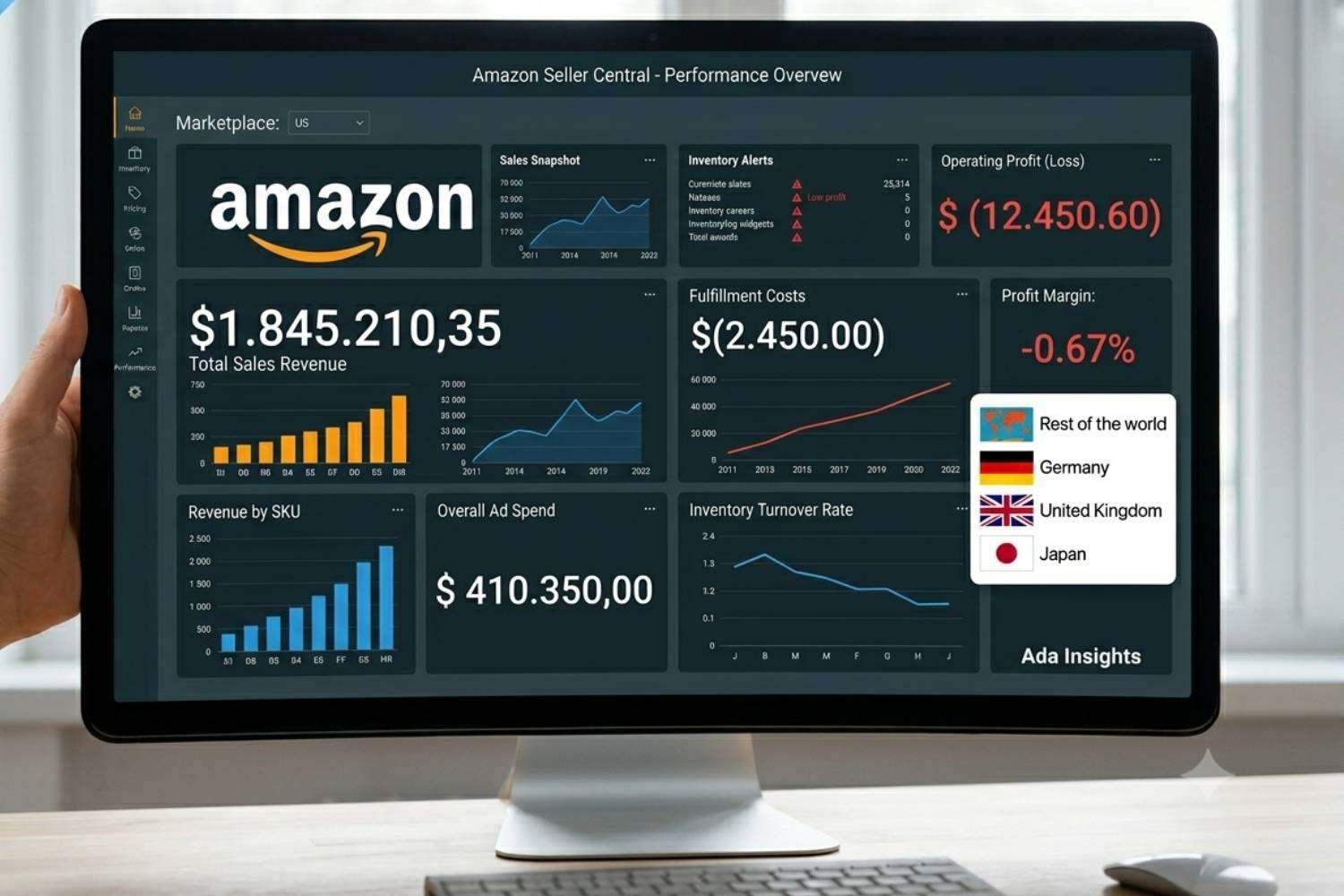
Revenue Growth Can Hide Profit Loss
Most Amazon sellers know their revenue.
Far fewer know their true profit.
And that’s where problems begin.
Across Amazon FBA businesses, FBM operations, private label brands, and multi-SKU sellers, data is everywhere.
Sales reports.
Advertising reports.
Inventory reports.
Financial reports.
Operational reports.
The issue isn’t a lack of information.
The issue is visibility.
Because revenue growth can hide declining margins, rising costs, and profitability issues for weeks—or even months.
By the time the problem becomes obvious, profit may already be impacted.
The Hidden Problem Behind Many Amazon Businesses
Many sellers believe more data leads to better decisions.
In reality, the opposite often happens.
As businesses grow, information becomes fragmented across:
- Amazon Seller Central
- Advertising platforms
- Inventory systems
- Financial tools
- Operational spreadsheets
Teams spend more time gathering information than acting on it.
What once took one report now requires multiple systems and multiple exports.
As data volume grows, visibility becomes harder to maintain.
Where Amazon Sellers Lose Visibility
Most profit problems don’t start with revenue.
They start with visibility gaps.
1. Ad Spend Leakage
Campaigns continue generating sales.
Revenue looks healthy.
But advertising costs grow faster than profitability.
Without visibility, sellers notice the spend long before they notice the margin impact.
2. Inventory Holding Costs
Inventory doesn’t just occupy warehouse space.
It consumes cash.
Storage fees.
Long-term storage charges.
Capital tied up in slow-moving inventory.
These costs quietly reduce profitability.
3. SKU Underperformance
A few successful products can make the overall business look stronger than it actually is.
Revenue leaders are not always profit leaders.
Without SKU-level visibility, underperforming products often remain hidden.
4. Profit Blind Spots
Revenue reports tell one story.
Profit tells another.
Fees.
Returns.
Advertising costs.
Fulfillment expenses.
Marketplace commissions.
These costs are often viewed separately rather than together.
5. Delayed Analytics
By the time monthly reports are reviewed, opportunities may already be missed.
Delayed visibility creates delayed decisions.
And delayed decisions often create lost profit.
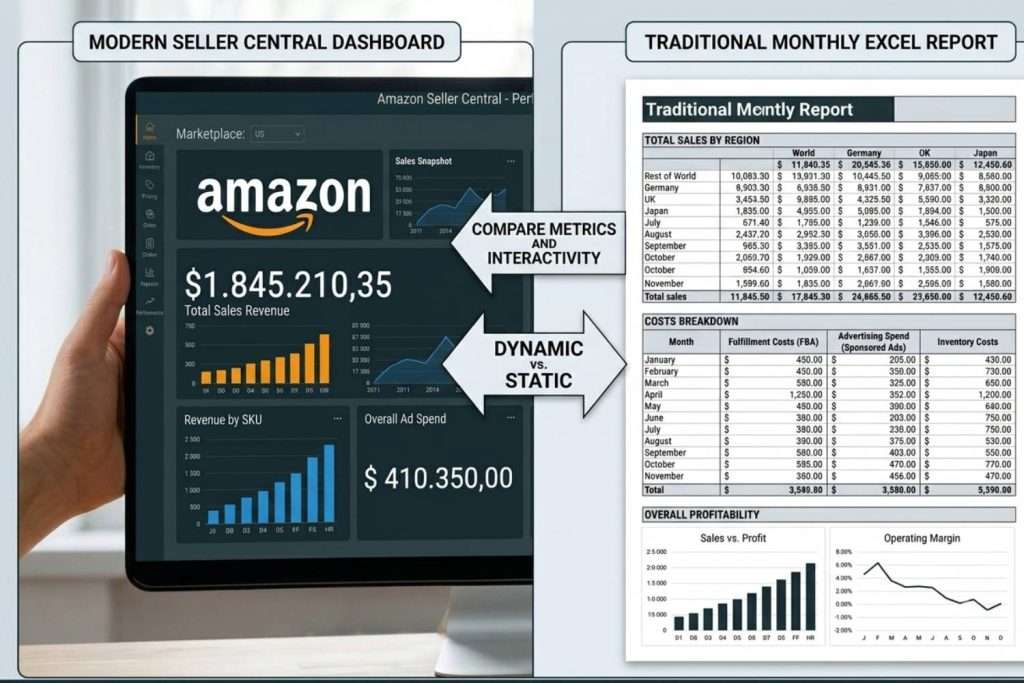
Why Traditional Reporting Is No Longer Enough
Amazon is a fast-moving marketplace.
Advertising costs change daily.
Inventory levels fluctuate constantly.
Competitors adjust pricing continuously.
Customer demand shifts rapidly.
Waiting days or weeks for reports creates a disadvantage.
Businesses need visibility while decisions can still be influenced.
Not after the outcome is already determined.
A Real-World Example: The Multi-SKU Amazon Seller
Consider an Amazon seller managing 500 SKUs.
Every day generates information related to:
- Orders
- Advertising spend
- Inventory levels
- Storage fees
- Returns
- Shipping costs
- Marketplace commissions
Using spreadsheets, the operations team spends hours assembling reports.
The information exists.
But visibility arrives too late.
The challenge is not collecting data.
The challenge is turning data into decisions quickly enough to matter.
The Cost of Limited Profit Visibility
When visibility breaks down:
- Profit erosion accelerates
- Cash flow pressure increases
- Inventory decisions become harder
- Advertising efficiency declines
- Growth becomes less predictable
Revenue may continue increasing.
Profit may not.
This is why revenue alone is not a reliable measure of business health.
Revenue Visibility Is Not Profit Visibility
This is the insight many growing sellers eventually discover.
Revenue tells you what happened.
Profit tells you whether it was worth it.
The most successful Amazon businesses focus on both.
Because profitability not revenue is what funds growth.
How ReportZapp Helps Amazon Sellers Improve Visibility
At ReportZapp, we help Amazon sellers connect:
- Sales performance
- Advertising costs
- Inventory metrics
- Marketplace fees
- Operational expenses
- Profitability reporting
into one decision-ready view.
Instead of switching between multiple reports, teams gain visibility into the metrics that matter most.
The objective is simple:
Help sellers see profitability sooner.
Because better visibility creates better decisions.
Before vs After Profit Visibility
Before
- Multiple spreadsheets
- Delayed reporting
- Revenue-focused decisions
- Limited SKU visibility
- Reactive management
- Unclear profitability
After
- Centralized visibility
- Faster reporting
- Profit-focused decision making
- Clear SKU performance insights
- Stronger margin awareness
- Better operational control
The Bigger Strategic Shift
The future of ecommerce reporting is not about generating more reports.
It is about generating better decisions.
The businesses that grow most effectively are not necessarily the ones with the most data.
They are the ones with the clearest visibility into profitability.
As marketplaces become more competitive, decision speed and decision quality will become even more important.
Both depend on visibility.
Amazon sellers have more data than ever before.
Yet many still struggle to answer simple questions:
- Which products are truly profitable?
- Which campaigns are generating profit?
- Which inventory is consuming cash?
- Which decisions deserve attention today?
The challenge is not reporting.
The challenge is visibility.
The businesses that gain visibility sooner can identify risks earlier, improve profitability faster, and make better decisions more consistently.
Because revenue growth alone does not guarantee business success.
Profit visibility does.
If your revenue increased by 20% next month…
Would you immediately know whether profit increased too?
If the answer is no, it may be time to evaluate how visibility is managed across your Amazon business.
See how ReportZapp helps sellers improve profit visibility, advertising insights, SKU analysis, and operational decision-making.
FAQ
What is Amazon profit analytics?
Amazon profit analytics helps sellers understand true profitability by combining revenue, advertising costs, fulfillment expenses, fees, inventory costs, and operational metrics into a complete financial picture.
Why is profit visibility important for Amazon sellers?
Profit visibility helps sellers identify margin erosion, advertising inefficiencies, inventory costs, and underperforming SKUs before they significantly impact profitability.
What is the difference between revenue and profit visibility?
Revenue visibility shows sales performance. Profit visibility shows whether those sales are generating sustainable financial returns after all costs are considered.
How can sellers improve SKU profitability?
By tracking advertising costs, inventory expenses, fulfillment fees, and margins at the SKU level, sellers can make better product and pricing decisions.
Why do Amazon sellers struggle with reporting?
Many sellers rely on multiple disconnected systems and spreadsheets, making it difficult to gain timely visibility into profitability and operational performance.
How does ReportZapp help Amazon sellers?
ReportZapp helps sellers connect sales, advertising, inventory, operational costs, and profitability metrics into a unified reporting environment that supports faster and more informed decision-making.