

Why Amazon Sellers Lose Profit Visibility, and How Dashboards Fix It
Most Amazon sellers are not struggling because they lack data.
They are struggling because they cannot act on it fast enough.
Revenue is visible.
Ad spend is visible.
Orders are visible.
But profit?
That’s where clarity breaks.
And that’s where decisions slow down.
The Real Problem Is Not Data
Across Amazon FBA and FBM businesses:
Data is everywhere.
Seller Central reports.
Ad dashboards.
Inventory tools.
But more data does not create clarity.
It creates friction.
Because decisions depend on visibility.
Not volume.
Where Amazon Operations Lose Visibility
1. Ad Spend Hides Profit Loss
Campaigns scale.
Sales increase.
But margins shrink quietly.
2. SKU Performance Gets Misread
Top-line revenue looks strong.
But weak-margin SKUs stay hidden.
3. Inventory Costs Stay Invisible
Storage fees increase.
Capital gets locked.
But the impact is not immediately visible.
4. Reporting Happens Too Late
Weekly reports come in.
But decisions needed to happen days earlier.
5. Data Stays Fragmented
Different tools.
Different reports.
Different teams.
No single view.

Operational Check (Save-Worthy)
Ask yourself:
- Which SKU is least profitable today?
- Which campaign is reducing margin?
- Which inventory is tying up the most cash?
If this takes time to answer—
Visibility is already delayed.
Business Consequences
These gaps create:
- Profit erosion
- Cash flow pressure
- Inefficient ad spend
- Poor SKU decisions
- Reactive operations
Operational Insight
This is not a data problem.
This is not a growth problem.
This is a visibility problem.
Revenue visibility is not profit visibility.
What Actually Improves Decision-Making
Better decisions come from structured visibility.
- Profit is tracked in real time
- SKU performance is clear
- Ad spend is tied to margins
- Inventory impact is visible
That’s what drives action.
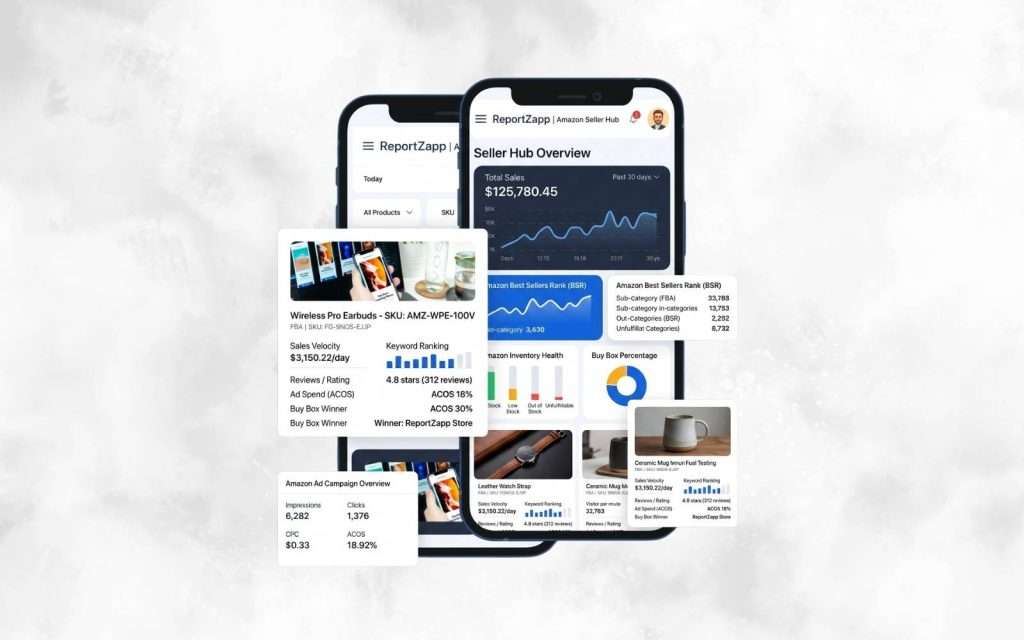
What an Effective Amazon Seller Dashboard Does
A strong amazon seller dashboard connects:
- Revenue
- Ad spend
- Fees
- Returns
- Inventory costs
Into one view.
This allows:
- Faster decisions
- Early risk detection
- Better profitability control
Where ReportZapp Fits
Most dashboards show data.
ReportZapp focuses on decision clarity.
Because that’s where sellers struggle.
ReportZapp connects:
- Sales data
- Advertising performance
- SKU analytics
- Profit metrics
Into one operational dashboard.
So sellers don’t just track performance.
They improve it.
Outcomes
- Faster profit visibility
- Better SKU decisions
- Stronger margin awareness
Sellers act earlier.
Risks become visible sooner.
Profitability becomes clearer.
Strategic Shift
Winning on Amazon is no longer about data access.
It’s about:
- Faster interpretation
- Better visibility
- Quicker execution
Amazon businesses don’t fail because of lack of effort.
They fail because they react too late.
Because:
Visibility is not reporting.
Visibility is control.
If your business still relies on fragmented reports and delayed insights—
The issue is not data.
It’s visibility.
👉 Explore how ReportZapp helps Amazon sellers improve decision-making with real-time dashboards.
FAQs
1. What is an amazon seller dashboard?
A centralized system that shows sales, profit, ad spend, and inventory insights in one place.
2. How does it improve decision-making?
By providing real-time visibility into key metrics, enabling faster and more accurate decisions.
3. Why is profit visibility important?
Because revenue alone does not reflect true business performance.
4. What should a dashboard include?
Profitability, SKU performance, ad spend, inventory, and operational insights.
5. Who benefits most?
Amazon FBA sellers, FBM sellers, aggregators, and high-volume brands.