Amazon’s ecosystem continues to evolve.
Fee structures adjust.
FBA rates change.
Storage rules tighten.
Advertising costs fluctuate.
Return processing fees increase.
Most of these changes are incremental.
That is precisely the risk.
Small percentage increases across fulfillment, storage, advertising, and returns do not create immediate alarm. But over weeks and months, they compress margins quietly and consistently.
When visibility is delayed:
In 2026, profitability will not depend only on revenue growth.
It will depend on margin protection.
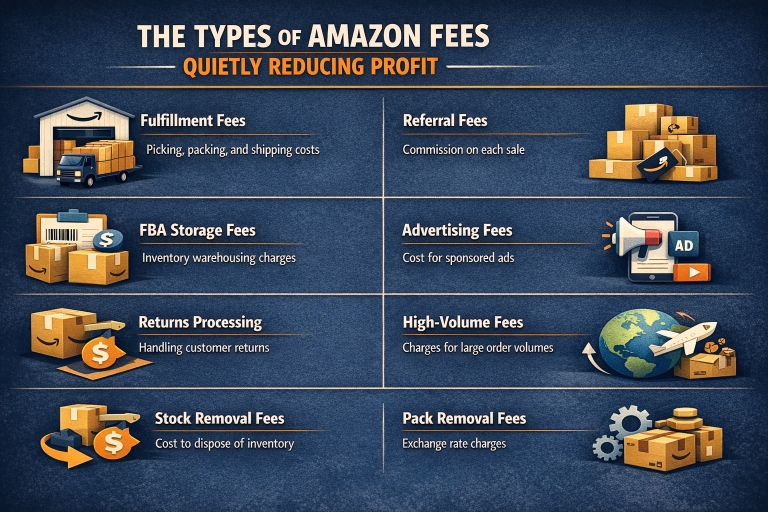
Many sellers focus on referral and FBA fees.
But real margin erosion often comes from secondary or variable costs.
Common hidden drain points include:
Individually, these appear manageable.
Collectively, they reshape profit reality.
The challenge is not a lack of data.
The challenge is fragmentation across multiple reports.
Amazon provides extensive reporting.
But volume does not equal clarity.
Sellers often experience:
By the time margin compression becomes obvious, corrective action becomes reactive rather than strategic.
In a competitive marketplace, delayed awareness equals lost leverage.

ReportZapp, built by Zamorins Solutions Inc, is designed to help sellers detect financial shifts earlier and with greater precision.
Instead of navigating multiple Amazon reports, sellers gain structured financial visibility in one consolidated environment.
ReportZapp enables sellers to:
The objective is not more data.
It is earlier detection of margin erosion.
Amazon operators use ReportZapp as part of routine financial oversight.
Common use cases include:
When fee visibility improves, pricing becomes more accurate.
When margin clarity improves, scaling becomes safer.

Amazon in 2026 will reward operational discipline.
Revenue growth alone will not define success.
Margin awareness will.
Hidden fees do not arrive dramatically.
They accumulate quietly.
Sellers who build systems for continuous financial visibility respond faster, price smarter, and scale with greater confidence.
Tools like ReportZapp transform fragmented Amazon data into structured financial intelligence.
In a marketplace where small cost shifts redefine performance, clarity is not optional.
It is strategic infrastructure.
ReportZapp is best software platform manage your sales depends on your specific business needs budget & industry.